Westhill Community Church
23rd November 2025
Does God Do Miracles?
Reading: Joshua 10
On reading this tenth chapter of Joshua, following on from the earlier chapters, I have been struck by three principles that just seem to stand out so clearly. The first of these is that God keeps His word. These passages are all about the people of Israel being brought by God into an inheritance that He had promised long, long ago to their forefather Abraham. The second principle is that God works wonders. When God fulfils His purposes nothing is impossible for Him to do. The third principle is that God will destroy the wicked. This is written on almost every page, not just of the book of Joshua but in the entire Bible from start to finish. Let’s look at each of these principles in a bit more detail.
God keeps His word
First of all, God keeps His word. Way back in the Garden of Eden God had solemnly promised that One would come, born of a woman, who would crush the evil serpent’s head and destroy his wicked works. And as God prepared the way for this great plan of redemption to be fulfilled He met with Abram, and spoke to him.
“Go from your country, your people and your father’s household to the land I will show you. I will make you into a great nation, and I will bless you … and you will be a blessing.” … Abram travelled through the land. ... At that time the Canaanites were in the land. The Lord appeared to Abram and said, “To your offspring I will give this land.” (Gen 12: 1-7)
In the book of Joshua, and here in chapter 10 particularly, we see the promise to Abraham, and the eventual plan of redemption through Christ, starting to be fulfilled. Here is what Moses had said to the people of Israel just before he died:
“It was because the Lord loved you and kept the oath he swore to your ancestors that he brought you out with a mighty hand and redeemed you from the land of slavery. … Know therefore that the Lord your God is … the faithful God, keeping his covenant of love to a thousand generations of those who love him and keep his commandments.” (Deut 7: 8-10)
Now in this chapter 10 of Joshua we have the fascinating account of how five of the Amorite kings agreed together to attack and destroy Gibeon. As we saw last week the Gibeonites had made a treaty of peace with the Israelites, by means of trickery, and the other inhabitants of the land despised them for doing this and conspired together to attack them. What fascinates me about this account is that the entire campaign recorded in chapter 10, through which southern Canaan was conquered by the Israelites, was sparked off by Joshua rushing to defend the Gibeonites. And in this we see the amazing grace of God – not just mercy for those who had sought sanctuary by deceptive means, but a rich outpouring of grace. God performed miracles for these Gibeonites. Humanly speaking we might be tempted to ask why. After all hadn’t God himself commanded the Israelites not to make any peace treaties with the inhabitants of the land: “Make no treaty with them, and show them no mercy” (Deut 7:2). So when the Gibeonites secured a peace treaty by deception we might have expected Joshua to just shrug his shoulders when they were attacked by their neighbours, and say “Serves them right – on their own head be it.” But no! No time or effort was spared in rushing to defend the besieged city, and we know quite definitely that Joshua was acting fully in line with God’s will. How do we know this? Because about 300 years later King Saul, in his folly, started slaughtering the Gibeonites in an attempt to eradicate them completely, and God brought judgement on the whole land because of his sin (2 Sam 21). God continued to defend the Gibeonites.
The Gibeonites had placed themselves under God’s protection. Oh, they may have used questionable means to achieve this, but the essential point is this: they did it because they believed God and believed that he will keep his word. When they first met with Joshua they said, “We have heard reports of all that the Lord your God has done for you” (Josh 9: 9,10). Previously Rahab had said to the two spies, “When we heard of it, our hearts sank and everyone’s courage failed because of you, for the Lord your God is God in heaven above and on the earth below.” (Joshua 2: 11) The people of Gibeon were much the same. They heard and believed, and consequently sought to change their ways. And those wonderful words recorded earlier in scripture, speaking of Abraham, (“Abram believed the Lord, and he credited it to him as righteousness” – Gen 15: 6) apply to Rahab and the Gibeonites too. Did they deserve mercy? No, like the rest of the land they were steeped in wicked ways, so much so that God’s judgement and wrath was being poured out. Did they deserve grace? No, they were deceivers and tricksters. But they believed God. Hebrews 11 verse 6 says, “Without faith it is impossible to please God, because anyone who comes to him must believe that he exists and that he rewards those who earnestly seek him.” The Gibeonites believed, they earnestly sought, and they were rewarded with God’s provision and protection.
God works wonders
Not only does this passage teach us that God keeps His word. It also tells us that God is a God who works wonders. Two incidents in particular speak of miracles God performed that day to ensure His purposes were fulfilled: the large hailstones that rained down on the fleeing Amorite armies, and the sun standing still.
Now the passage is full of the names of cities and kings that most, if not all, of us are completely unfamiliar with. So to help I’ve put together a diagram showing some of the places named.
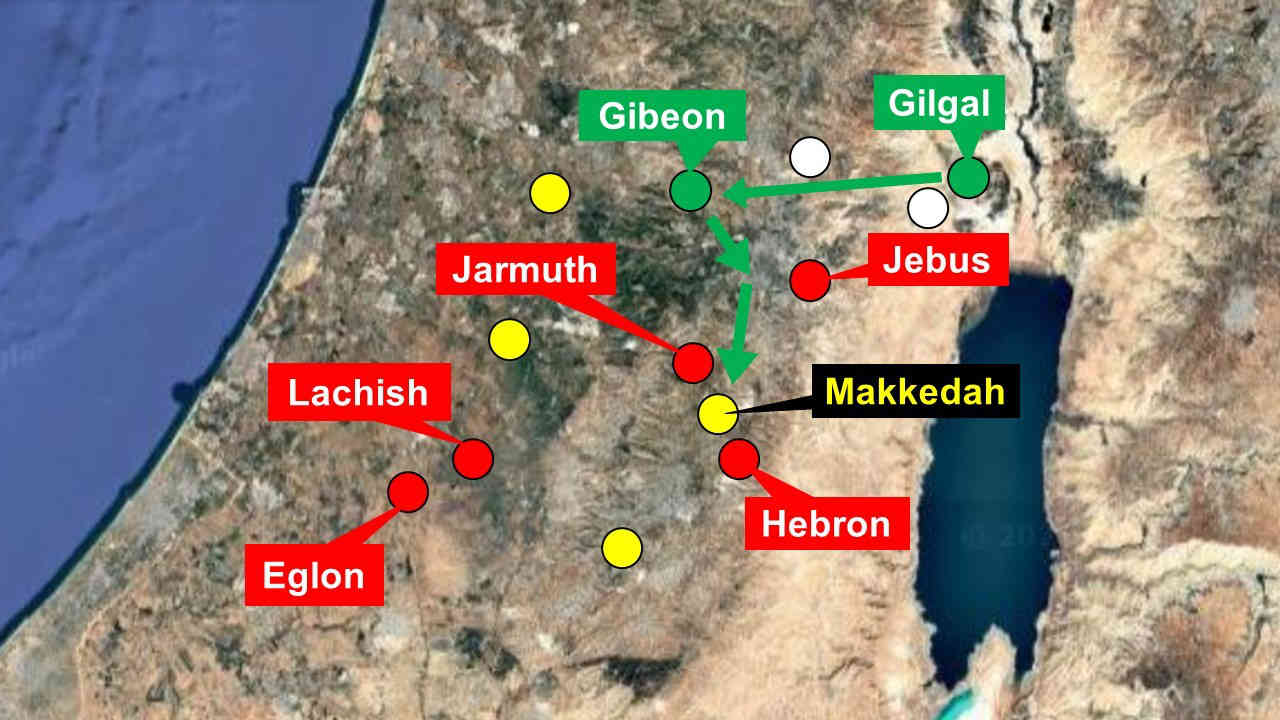
What you can see is a satellite image of southern Israel (downloaded from Google Maps). On this picture I’ve placed the approximate locations of various cities mentioned in the text. Coloured green are Gilgal, in the Jordan valley, where the Israelite’s main camp was located, and Gibeon that had surrendered to the Israelites. The green arrows show the route followed by Joshua’s army, firstly up the steep western slopes of the Jordan valley to the city of Gibeon, and then to Makkedah where the five Amorite kings were eventually captured. The red circles are the five cities that conspired together to attack Gibeon, and the lead city of course was Jerusalem On the map I’ve used the name Jebus, since this city was not called Jerusalem until King David captured it some 350 years later. The yellow dots show the locations of other cities that Joshua defeated in this campaign, or that came to aid the others and were defeated with them.
Now Joshua’s army marched all through the night from Gilgal to Gibeon, taking the besieging Five King’s armies by surprise. The besieging armies fled before Joshua’s men. At first they aimed for Beth Horon, then headed south towards Makkedah. Here the first miracle took place. Huge hailstones rained down on the fleeing armies, and the record informs us that these hailstones killed more men than Joshua’s pursuing army did. Then another miracle is described, this one even more amazing. We read that Joshua prayed to God and called for the sun and the moon to cease moving, and we read that the sun ceased going down for the best part of a day, giving Joshua’s army sufficient daylight hours to pursue and destroy their enemies.
Now if we are honest I suspect that most of us read about the miracle of the hailstones without too many questions. We can imagine how God could use weather conditions to cause massive lumps of ice to drop from the sky. Maybe the main miracle here was getting the timing right to catch the fleeing armies.
But stopping the sun in its tracks, that seems to be another matter altogether! leaving aside what means could be used to stop the earth rotating, the plain fact is that if the earth were to suddenly stop spinning, thus keeping the sun in its apparent position in the sky, people and things not deeply anchored to the ground in southern Israel (to say nothing of the rest of the planet!) would suddenly be propelled in an easterly direction at 889 miles per hour. Nobody would survive. Even just slowing the earth’s rotation would cause mayhem. So maybe it’s not surprising that so many sceptics have scoffed at this account or questioned its reliability.
But an approach that says “If I can explain it or imagine it then I’ll believe it, but if I can’t explain it or imagine it then I won’t believe it” is clearly foolish. The basic question is this: does God act within our natural world in order to accomplish His own purposes and intentions? If the answer is “Yes” then why on earth should it make any difference whether we can explain how God carries out those purposes, and why indeed should we expect to understand His methods?
And of course God does indeed act within our natural world in order to accomplish His own purposes and intentions. Jesus taught us to pray, “Thy will be done, here on earth.” He said to his disciples, “My Father is always at his work to this very day, and I too am working” (John 5:17).
It seems to me that there are generally two different ways that God acts within our natural world in order to accomplish His purposes. The first is that He uses natural processes, causing them to work together to achieve the desired end, ensuring appropriate coincidence of time and place where necessary. Maybe the hailstones were an example of God working in this way. But God can also act in a way that seems to suspend natural processes, accomplishing something that natural processes by themselves could never do. So in our Bible passage today He delayed sunset for the best part of a day. Perhaps the greatest example is when He raised Jesus from the dead.
Maybe these pictures will help make this clearer.

This first picture shows a child playing with a toy train set. He’s controlling the train, getting it to do what he wants, but he’s using the built-in processes to do this via a remote control. This illustrates one way that God works in our world, and in our lives too. Philippians 2:13 says, “It is God who works in you to will and to act in order to fulfil his good purpose.”

The second picture shows the same child with the train set, but this time he’s intervening directly to do something that the built-in controls could never do. He’s lifting the train off the tracks, and is about to place it somewhere else. And this illustrates how God will sometimes intervene in a miraculous way to accomplish His will. Jesus said, “All things are possible with God” (Mark 10:27).
From God’s point of view perhaps there is actually no difference. He can perform miracles using natural processes, and He can perform miracles by intervening directly; how He accomplishes His purposes is not our concern. We just need to remember that nothing is impossible for Him, and He invites us to come to Him in expectation, confidence and faith.
God will destroy the wicked
The third principle that stands out to me in this passage is this: God will destroy the wicked. It is not just these chapters that teach this sober truth, but the whole of the Bible from beginning to end. When writing to the Romans Paul made this very clear.
The wrath of God is being revealed from heaven against all the godlessness and wickedness of people, who suppress the truth by their wickedness. (Rom 1: 18)
Do you show contempt for the riches of his kindness, forbearance and patience, not realising that God’s kindness is intended to lead you to repentance? But because of your stubbornness and your unrepentant heart, you are storing up wrath against yourself for the day of God’s wrath, when his righteous judgment will be revealed. (Rom 2: 4,5)
Joshua 10 is a picture, a foreshadowing, of what Paul calls “the day of God’s wrath.” It was Jesus himself who revealed to his disciples on the road to Emmaus that the whole of the Old Testament speaks about him, so we should not be surprised that when God used Joshua and the armies of Israel to destroy the ungodly inhabitants of Canaan he was painting a picture of what Christ himself has come to do.
The apostle John said, “The reason the Son of God appeared was to destroy the devil’s work” (1 John 3: 8).
Paul wrote in his second letter to the Thessalonians, “When the Lord Jesus is revealed from heaven in blazing fire with his powerful angels he will punish those who do not know God and do not obey the gospel of our Lord Jesus. They will be punished with everlasting destruction.” (2 Thess 1: 7-9)
And of course, this is what the gospel of salvation is all about. What did Jesus say to Nicodemus when he met with him?
“For God so loved the world that he gave his one and only Son, that whoever believes in him shall not perish but have eternal life. For God did not send his Son into the world to condemn the world, but to save the world through him. Whoever believes in him is not condemned, but whoever does not believe stands condemned already because they have not believed in the name of God’s one and only Son.” (John 3: 16-18)
Brothers and sisters, the fact that Jesus had to come into this world in order to suffer and die to pay the penalty for our sins tells us beyond any doubt that God’s wrath is real, and in due time it will be poured out on all who do not trust in Jesus for salvation. And this should give urgency to our response to Christ’s command to be his witnesses in this fallen world. Yes, we are called to feed the hungry; yes, we are called to help the weak. Yes, we are called to show love to the unlovely. But over and above all of these things we are called to share with others the terrible consequences of our sin, and the amazing provision of salvation accomplished by Jesus on the cross because of the love of God.
