Westhill Community Church
Sunday 15th March 2026
Lax Lots
Reading: Joshua 18:1-11 & 19:40-51
Introduction
Our reading this morning describes a time in the history of the Israelites after they had made significant advances in their occupation of the Promised Land, but when they still had a long way to go.
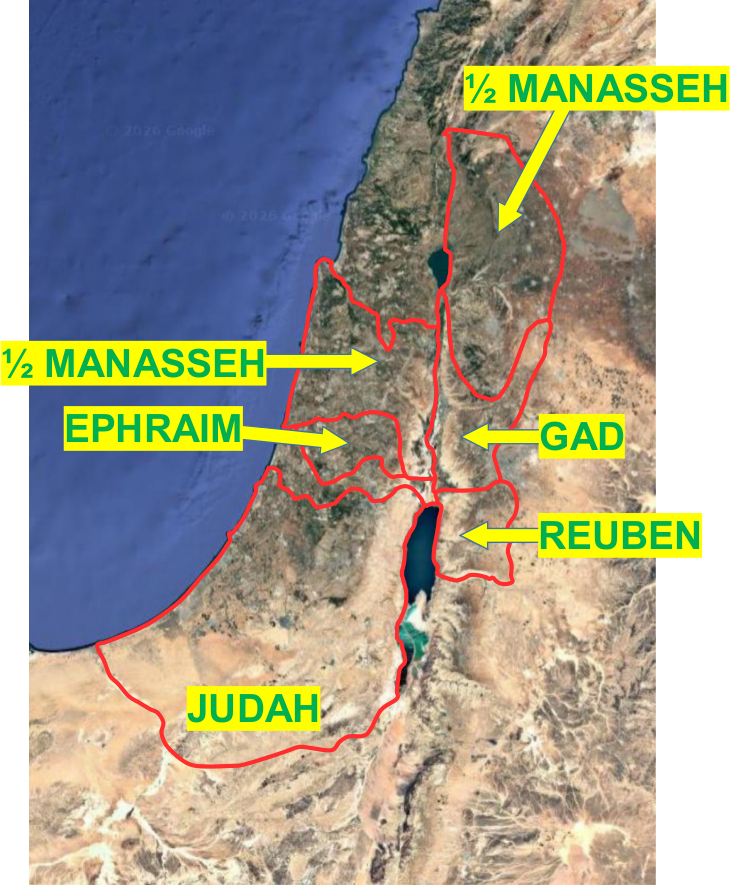 This picture contains a
recent satellite image of the land, with the tribal territories marked in red.
Five tribes had so far received their allocation of land: Manasseh (half on the
east and half on the west of the Jordan river), Gad, Reuben, Judah and Ephraim.
Remember that although Jacob had twelve sons there were actually thirteen
tribes, since Jacob said that Joseph’s two sons, Manasseh and Ephraim, would be
counted as his own sons. Thirteen tribes, but only twelve territories were
allocated, since Levi, the priestly tribe, had no inheritance of land.
This picture contains a
recent satellite image of the land, with the tribal territories marked in red.
Five tribes had so far received their allocation of land: Manasseh (half on the
east and half on the west of the Jordan river), Gad, Reuben, Judah and Ephraim.
Remember that although Jacob had twelve sons there were actually thirteen
tribes, since Jacob said that Joseph’s two sons, Manasseh and Ephraim, would be
counted as his own sons. Thirteen tribes, but only twelve territories were
allocated, since Levi, the priestly tribe, had no inheritance of land.
So, there were still seven tribal territories to be decided. Joshua 18 and 19 describe the way in which Joshua directed the people to do this.
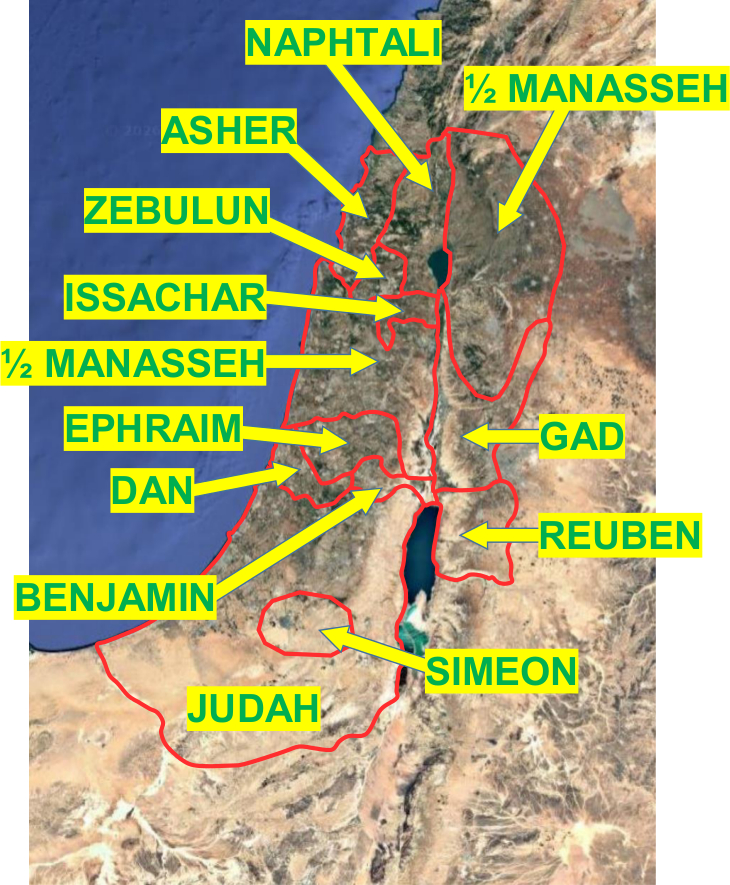 First of all the Tabernacle
– the tent in which they met with God – was moved from Gilgal, near Jericho,
where it had been for about 14 years, to Shiloh. Shiloh was located in the hill
territory of Ephraim, roughly in the centre of the entire land inherited by
Israel. Secondly explorers were chosen, three from each tribe, to explore the
land and bring back a report to Joshua. The land not yet occupied was to be
split up into seven parts, although we see from the beginning of chapter 19
that in practice only six new areas of land were needed, since the tribe of
Simeon was given territory previously allocated to Judah. Thirdly they sought
God’s guidance as to which territory should be allocated to which tribe, using
a method of casting lots. This picture shows the result.
First of all the Tabernacle
– the tent in which they met with God – was moved from Gilgal, near Jericho,
where it had been for about 14 years, to Shiloh. Shiloh was located in the hill
territory of Ephraim, roughly in the centre of the entire land inherited by
Israel. Secondly explorers were chosen, three from each tribe, to explore the
land and bring back a report to Joshua. The land not yet occupied was to be
split up into seven parts, although we see from the beginning of chapter 19
that in practice only six new areas of land were needed, since the tribe of
Simeon was given territory previously allocated to Judah. Thirdly they sought
God’s guidance as to which territory should be allocated to which tribe, using
a method of casting lots. This picture shows the result.
Now there are three lessons in particular that we can learn from these accounts.
1. A Task to be Completed
The first is that there was a task that still needed to be completed.
So Joshua said to the Israelites: ‘How long will you wait before you begin to take possession of the land that the Lord, the God of your ancestors, has given you? (Joshua 18:3)
Joshua sounds impatient, doesn’t he? “What are you waiting for?” he exclaimed. This is no time to be sitting back enjoying the fruits of your labours so far. Maybe some were beginning to lose interest; others perhaps were longing for a normal, settled lifestyle. Maybe some had already got what they were looking for and couldn’t be bothered with the needs of others. For one reason or another Joshua needed to challenge God’s people once again and stir them into action. The task was still not completed.
I am reminded of the words of Bishop Frank Houghton, written 95 years ago in 1931. Frank Houghton was an Anglican missionary bishop who served with the China Inland Mission (CIM). He was director general of CIM when the mission was forced to leave China in 1950-51 when the communists came to power. CIM later changed its name to the Overseas Missionary Fellowship (OMF) that we know and support today. Frank Houghton wrote these words in a much-loved hymn.
Facing a task unfinished
that drives us to our knees,
A need that, undiminished,
rebukes our slothful ease,
We who rejoice to know you
renew before your throne
The solemn pledge we owe you
to go and make you known.
If I were to ask you, “What does God call on the church to do today?” I might receive various responses. Some would say that our task is to love Him with all our heart, and love our neighbour as ourselves, and of course this is true. Others might say that the church is to be salt and light in society, to keep it from becoming corrupt, and of course this is true as well. Still others might respond that we must maintain a close relationship with Jesus so that our lives bear fruit that honours him – fruit such as love, joy, peace, patience, and so on, and of course this is true as well. But as well as all these things, and many others, Jesus gave one clear instruction to his first disciples and by implication to all those who follow him, the instruction we call “The Great Commission.”
Then Jesus came to them and said, ‘All authority in heaven and on earth has been given to me. Therefore go and make disciples of all nations, baptising them in the name of the Father and of the Son and of the Holy Spirit, and teaching them to obey everything I have commanded you. And surely I am with you always, to the very end of the age.’ (Matt 28:18-20)
So you see, just as Joshua stood before the people of God long ago and said, “What are you waiting for,” so Jesus stands before all God’s people today and says, “What are you waiting for?” There is an inheritance to be possessed. “What inheritance?” you may ask. It is Jesus’ inheritance, but one he instructs us, as his body, to take possession of. Psalm 2 says this of Jesus.
I will proclaim the Lord’s decree. He said to me, ‘You are my son; today I have become your father. Ask me, and I will make the nations your inheritance, the ends of the earth your possession. (Psalm 2:7,8)
The nations are his inheritance. How can we be sure that we can apply these words to Jesus? Because the New Testament assures us that all such promises are fulfilled in him, and that we can pray in faith for their fulfilment.
For no matter how many promises God has made, they are ‘Yes’ in Christ. And so through him the ‘Amen’ is spoken by us to the glory of God. (2 Cor 1:20)
God’s intention, God’s promise indeed, is that the nations to the ends of the earth will belong to Jesus, will own him as Lord and will submit to his authority. And that includes your nation, all the nations we come from, this nation, this town, this community.
There is a hymn Christians often sing that expresses so powerfully the wonderful truth that there is a day coming when every knee will bow to our Saviour Jesus: the words were written by William Fullerton a century ago. It is sung to the traditional Irish folk melody Londonderry Air. These are the last two verses.
I cannot tell how He will win the nations,
How He will claim His earthly heritage,
How satisfy the needs and aspirations
Of east and west, of sinner and of sage.
But this I know, all flesh shall see His glory,
And He shall reap the harvest He has sown,
And some glad day His sun shall shine in splendour
When He the Saviour, Saviour of the world, is known.
I cannot tell how all the lands shall worship,
When, at His bidding, every storm is stilled,
Or who can say how great the jubilation
When all the hearts of men with love are filled.
But this I know, the skies will thrill with rapture,
And myriad, myriad human voices sing,
And earth to heaven, and heaven to earth, will answer:
At last the Saviour, Saviour of the world, is King.
This is the first point then: there is a task that is still unfinished.
2. A Land to be Surveyed
The second point is this: the land needed to be surveyed.
So the men left and went through the land. They wrote its description on a scroll, town by town, in seven parts, and returned to Joshua in the camp at Shiloh. Joshua then cast lots for them in Shiloh in the presence of the Lord, and there he distributed the land to the Israelites according to their tribal divisions. (Joshua 18:9,10)
In order to fully enter into their inheritance the people of Israel needed to understand the extent of the task lying before them, to identify what needed to be done and then to allocate responsibilities for accomplishing what was needed. Without this exercise they might well move in the completely wrong direction, spend their energies on something completely irrelevant, or fail to take into account something vital to the success of their mission. But above all they needed to know that the plans they were making had God’s full approval and blessing, that they were fulfilling His will, not merely their own ideas.
There were three things that the people of Israel had to do as they completed this survey of the land yet to be occupied.
First they had to assess what needed to be done. “To make a survey of the land and to write a description of it” (Josh 18:4,5). They had to understand the situation, be aware of the opportunities and of the difficulties they would face.
Secondly they had to seek God’s direction “I will cast lots for you in the presence of the Lord our God” (Josh 18:6). This whole exercise was not their idea, their battle or their plan. It was God’s, so it was of paramount importance that they sought and followed His direction. The casting of lots was not done to randomize the allocation of land: it was an act of faith, trusting that God would determine the outcome.
Thirdly they had to assign responsibilities “He distributed the land to the Israelites” (Josh 18:10). The territory was divided up, and responsibility for taking possession was allocated to different tribes as God had directed.
So what about our own situation here in Westhill Community Church, or your situation if you are a visitor or watching remotely and belong to a different church? If we are to complete the task that Christ has given us, if we are to play our part in bringing the nations to bow the knee before His throne, then we too need to go through a similar process. We need to assess what needs to be done. We need to pray for God’s guidance and direction. And we need to assign people to specific tasks and ministries in order to follow where God leads us.
Oh of course it’s tempting to focus instead just on what we have been doing, particularly when resources may already be stretched. So, for example, we seek to maintain our ministry amongst children, and indeed grow it, and we are thankful for those additional folk who have recently committed to helping with Roar and with the crèche. But what about the large numbers of children in our community who have never heard that Jesus loves them and wants to be their Saviour and Lord? Surely God wants to reach them too, does He not?
We all regularly pray the Lord’s prayer I am sure. So when we pray “Your kingdom come, Your will be done,” should we not also be praying, “Lord, show us where particularly you want us as a church, and me as an individual, to pray and plan and work in order to see your kingdom grow and many others come to acknowledge you as Saviour and Lord.”
Well praise God that He has been guiding and encouraging us, as well as Kingshill Church of Scotland and Scripture Union here in the North-East of Scotland. All of us are praying that Scripture Union groups will be established in every school in this area. There is already a group in Westhill Academy, and this Spring a new group is starting in Crombie Primary. But our prayer is that all the other schools in the surrounding community will also have Scripture Union groups in the near future. We pray for this when we come together for prayer in our individual churches. There’s a Scripture Union prayer hub, too, that meets regularly to pray for the local schools: the next meeting is 22nd April at 7 pm, here in this church.
This is just one way that God has been leading us to “survey the land,” and I’ve no doubt there will be many others. God wants to win not just the present generation of children in our community for Jesus, but also the teenagers, the young adults, and the older generations. He calls us to build his Kingdom, and not just here in our community but also in far off places. So let’s increasingly explore ways of achieving this, praying together to seek God’s plan and direction, and then let’s commit ourselves to use whatever gifts He gives us and opportunities He presents before us to build His Kingdom.
The first point then is that the task is still not completed. The second point that the land needs to be surveyed, and this involves assessing what needs to be done, seeking God’s direction and assigning the responsibilities.
3. A Folly to be Shunned
The third point is this: there is a folly to be shunned, a disastrous error to avoid.
(When the territory of the Danites was lost to them, they went up and attacked Leshem, took it, put it to the sword and occupied it. They settled in Leshem and named it Dan after their ancestor.) (Joshua 19:47)
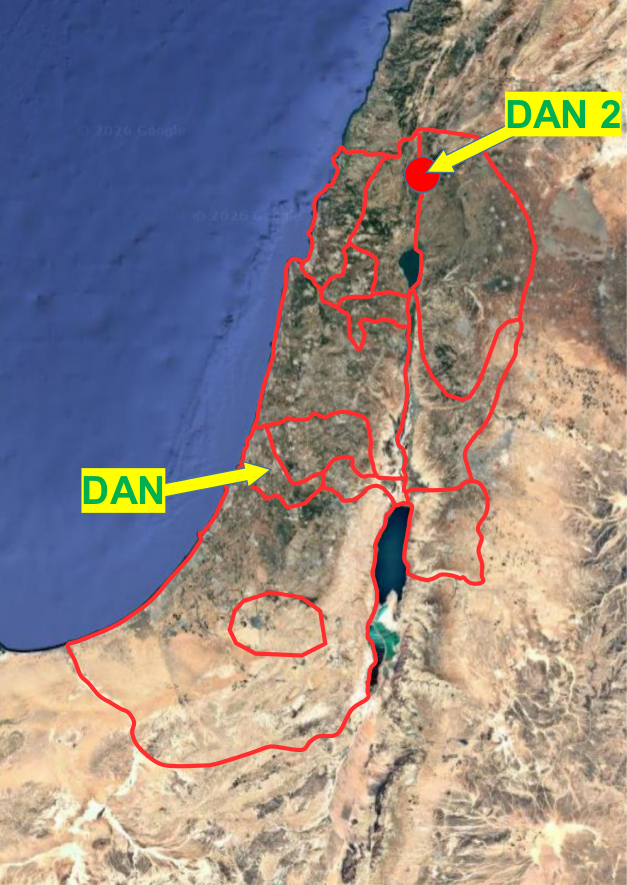 This verse tells us that the tribe
of Dan lost their inheritance, and they settled somewhere else. This picture
shows where they moved to, way up close to the northern border of Israel,
actually in territory that had been allocated to Naphtali or Manasseh. Judges
18 gives us more information. It tells us that the Danites were living in towns
in the hill country in the eastern part of their allocated territory, but apparently
did not have possession of the fertile coastal plain region. This area was
occupied by the Philistines right up to the time of king David, and it seems
that the Danites were unable or unwilling to take possession of that part of
their allocated territory. So they sent out a group of men to look for
somewhere else to live. They found a city called Leshem (called Laish in the
book of Judges) in a fertile region to the north, beyond the sea of Galilee, a
town occupied by a peaceful and prosperous people. After hearing the report of
the explorers the men of Dan armed themselves, marched to Leshem, catching the
people unawares, and totally destroyed it. The people of Dan then moved to
Leshem and settled there themselves, giving the city the new name Dan.
This verse tells us that the tribe
of Dan lost their inheritance, and they settled somewhere else. This picture
shows where they moved to, way up close to the northern border of Israel,
actually in territory that had been allocated to Naphtali or Manasseh. Judges
18 gives us more information. It tells us that the Danites were living in towns
in the hill country in the eastern part of their allocated territory, but apparently
did not have possession of the fertile coastal plain region. This area was
occupied by the Philistines right up to the time of king David, and it seems
that the Danites were unable or unwilling to take possession of that part of
their allocated territory. So they sent out a group of men to look for
somewhere else to live. They found a city called Leshem (called Laish in the
book of Judges) in a fertile region to the north, beyond the sea of Galilee, a
town occupied by a peaceful and prosperous people. After hearing the report of
the explorers the men of Dan armed themselves, marched to Leshem, catching the
people unawares, and totally destroyed it. The people of Dan then moved to
Leshem and settled there themselves, giving the city the new name Dan.
As they travelled to Leshem the armed men of Dan had to pass through the territory of Ephraim, and on their way they robbed a man living in the hill country, threatening him when he objected. They stole some household gods that he was using for worship, including an expensive idol made from silver. The book of Judges tells us that the people of Dan proceeded to worship that idol themselves for hundreds of years, all through the period of the Judges.
Dan’s folly consisted of three disastrous errors. Firstly they rejected the provision God had made for them. Joshua had said, “How long will you wait before you begin to take possession of the land that the Lord, the God of your ancestors, has given you?” and the people of Dan effectively replied, “It’s never going to happen!” Secondly they rejected God’s will, choosing to follow their own ideas instead of seeking God’s guidance. Then thirdly, to make matters worse, they chose to reject the Law of God that Moses and Joshua had insisted they must obey, not only stealing from a fellow Israelite but turning to idolatry instead of worshipping the one true God. It was such folly on the part of all the people of Israel at one time or another that led to these distressing words spoken by God to the prophet Jeremiah
My people have committed two sins: they have forsaken me, the spring of living water, and have dug their own cisterns, broken cisterns that cannot hold water. (Jer 2:13)
Turning aside from God’s will and purpose for your life is always something that sooner or later you will regret. Jonah found God’s call to preach to the people of Nineveh something he just couldn’t stomach, so he set off in the opposite direction. Later, in the depths of the ocean having been swallowed by a big fish he realised his folly and turned back to God. Jesus told a parable of a son who decided that life in his father’s service was not for him. He wanted to enjoy life in his own way. Later, sitting in rags in a pig field, forced to try some of the pig food for himself, he realised his folly and returned to his father.
In his gospel the Apostle John tells of a time when Jesus was teaching his followers about eternal life, and that many could not accept what he taught them. John records that this caused many of Jesus’ disciples to turn back and stop following him. Jesus then asked the twelve apostles whether they, too, planned to leave him. Simon Peter answered him, ‘Lord, to whom shall we go? You have the words of eternal life.’ (John 6:66-68).
Following Jesus is never easy. He himself said, “Whoever wants to be my disciple must deny themselves and take up their cross and follow me” (Matthew 16:24). We may find difficulties confronting us and obstacles blocking our path. We may not always see clearly which way to go. We may have to forego many things that are attractive to us. We may suffer the loss of things precious to us. And like some of those first disciples of Jesus we may be tempted to give up.
Satan whispers in our ear, “You will lose out on so much if you seriously attempt to follow Jesus. He demands so much of you. Better to make your own choices and go your own way.” But he fails to tell us that Jesus is the only one who provides eternal life. Only by following him can we experience rivers of living water; without him we are left only with broken cisterns.
The way ahead may be difficult. Many obstacles may block the path. We may not see clearly which way to go. But we do not turn back. Instead we cling to Jesus, putting our faith in his promises, trusting that his strength will be made perfect in our weakness. And we press on. “We do not belong to those who shrink back,” says the writer of Hebrews, “but to those who have faith and are saved” (Heb 10:39).
As I finish here is a verse from a worship song based on Paul’s words in Philippians 3:10-14
I will press on until I fully see
All God had planned when He laid hold of me.
Casting aside my self ability,
I will press on till Jesus comes for me.
https:../../Videos/IWantToKnowChrist.html
